PT Inocin Abadi and PT Tunas Timber Lestari have updated their timber cruising procedures based on wildlife monitoring results to ensure lek trees in their concession areas are identified and protected.
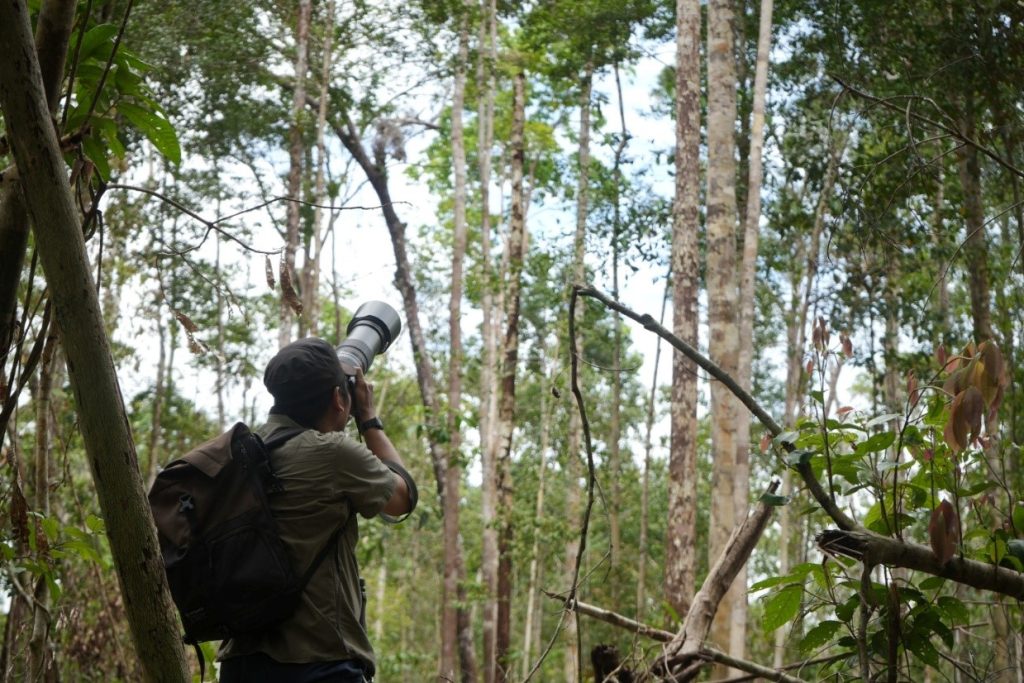
PHOTO: A researcher documenting lekking or mating display by greater birds-of-paradise (Paradisaea apoda) inside a South Papuan jungle. This observation is part of Papua Conservation, a conservation initiative by Korindo Group and IPB University
JAKARTA – Forestry companies under Korindo Group, PT Inocin Abadi (IA) and PT Tunas Timber Lestari (TTL), are strengthening habitat protection for greater birds-of-paradise (Paradisaea apoda) in South Papua through Papua Conservation, a program made in collaboration with IPB University.
Launched in 2022, the initiative includes research, mapping, and monitoring of lek trees, which are sites for the birds’ mating display. IPB University’s Prof. Ani Mardiastuti and her team lead the work.
In the process, one such tree was found to be part of the annual harvesting (RKT) block and harvest. This happened because IA and TTL had not established written rules or specific technical guidelines regarding lek locations.
The finding shaped the companies’ later decisions — improvements were made to operational procedures, including timber cruising, to enable identification and protection of lek trees prior to inventory. (Timber cruising is the process of inventorying a forest before logging.)
Research and monitoring outcomes provided important input for natural forest and plantation management, said Isok Winarjanto, Korindo Group’s forest utilization business permit (PBPH) manager, on Monday (9/14).
“From the monitoring, we gained valuable insights [into what needed fixing]. We followed this up with corrective measures and procedure improvements.”
In doing so, IA and TTL abided by a technical guideline by IPB University, “Panduan Sederhana bagi Masyarakat untuk Mengidentifikasi Pohon Lek Cenderawasih Kuning Besar” (A Simple Guide to Identifying Greater Bird-of-Paradise’s Lek Trees).
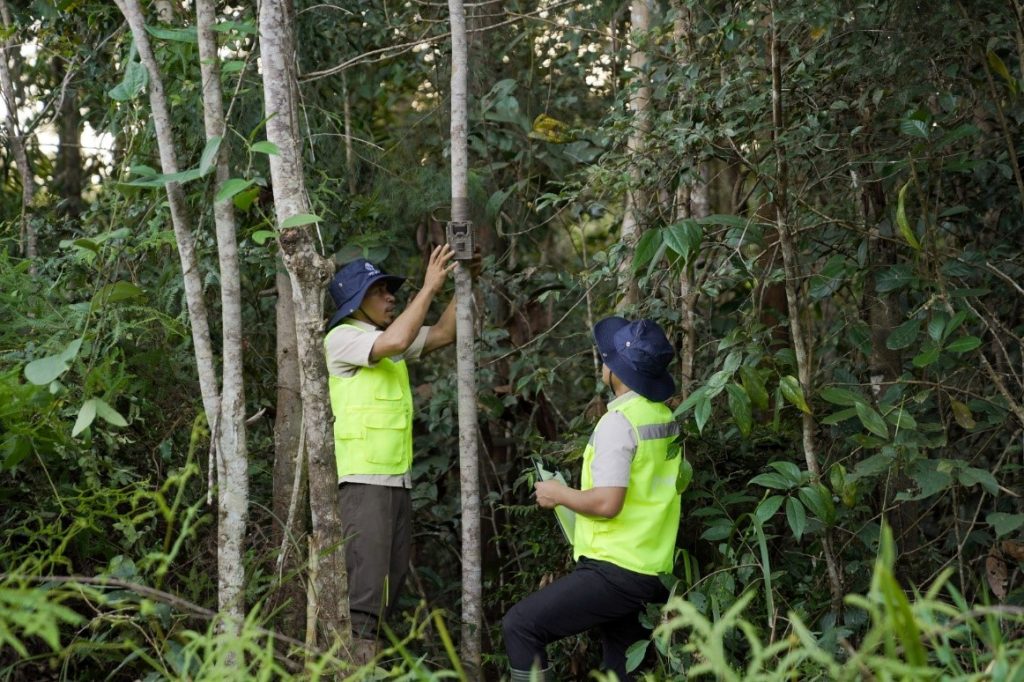
PHOTO: Two researchers mount a camera trap on a tree trunk to monitor and record greater birds-of-paradise sightings in their natural habitat
Their timber cruising procedures now start with lek tree identification, using bird sounds as the first cue. This step will take place during the breeding season, or between May and September. Next is direct observation, where greater birds-of-paradise are observed for their courtship activities. A tree is confirmed as a lek site when more than two adult males are found there, lekking simultaneously or in turn.
This tree will then be recorded with GPS coordinates, marked with conservation signage, and excluded from the annual harvesting plan (RKT) to preserve its ecological functions.
To enforce these new procedures, the IPB University team was recently brought in to conduct outreach and training for IA and TTL’s operational managers, timber cruising teams, and ESG staff.
“[Our] Papua Conservation [program] with IPB University allows us to combine scientific knowledge with on-the-ground experience, which helps us get a better picture of our concession areas and improve their management,” Isok added.
“Biodiversity protection is integral to responsible forest management. We will continue to use these [greater birds-of-paradise] monitoring results to inform how we evaluate and refine harvesting practices.”
Alongside IPB University, IA and TTL strive to promote science-based forest management that focuses on environmental sustainability and safeguarding of endemic species’ habitats in Papua. (*)